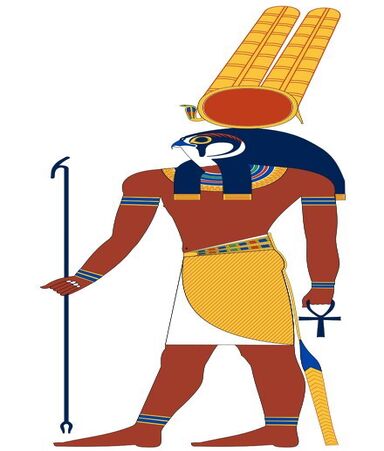
Among the pantheon of Neteru—divine principles—within the ancient Kemetic (Egyptian) spiritual tradition, Montu stands as one of the earliest and most formidable deities of war, sovereignty, and solar power. Often represented with the head of a falcon, adorned with two plumes and a solar disk, Montu was the personification of divine might, justice, and victorious kingship. Although later overshadowed in iconography by Heru (Horus) and Ra in the more popular dynastic periods, Montu’s cult is among the oldest in Kemet, emerging from the Theban region and spreading influence far beyond the Nile Valley.
Montu was more than just a War God but was the Ancestral prototype of Divine solar kingship among Bantu-speaking peoples of Sub-Saharan Africa. Drawing on linguistics, cultural anthropology, comparative mythology, and iconographic symbolism, it traces Montu’s association with falcon symbolism and sacral kingship into the heritage of the Bantu peoples—those who migrated southward in the millennia following Kemet’s rise. It ends with an analysis of how later Egyptian pharaohs, particularly Montuhotep, sought to legitimize their rule by associating with Montu, drawing upon a deep African matrix of sacred kingship tied to the falcon spirit.
I. Montu in Kemetic Theology: The Solar Warrior
Montu, known also as Mentu, Monthu, or Mont, was one of the earliest known war deities of ancient Kemet. Emerging primarily in Upper Egypt—particularly the Theban region—Montu was the patron god of warriors, battle, and sovereign strength. He was associated with scorching solar energy, the fury of the midday sun, and divine aggression used in the defense of Ma’at (cosmic order and balance).

Montu’s imagery was unmistakable: a falcon-headed god, crowned with the sun disk and two tall plumes, sometimes wielding weapons or shown in the act of smiting enemies. In this form, he bears resemblance to other solar-falcon deities like Heru (Horus), but predates the more dynastic manifestations of Heru and Ra-Horakhty. Some representations also show him as a bull—a sacred manifestation of virility, fury, and leadership, reinforcing his associations with strength and kingship.
In some hymns and inscriptions, Montu was called “the strong arm of Ra,” “the slayer of the enemies of Ra,” or “the Lord of Thebes.” His spiritual base was centered in the triad of Thebes, where he appeared alongside Mut and Khonsu before being integrated into the cults of Amun during the 11th Dynasty. His temples, most notably in Hermonthis (modern-day Armant), Medamud, and Tod, celebrate his military conquests and divinity.

Montu’s strength was never arbitrary. As a Neter aligned with solar power, he wielded war in service of Ma’at. His aggression was sacred, not chaotic—a divine force summoned to restore or defend order. This principle formed the core of the ideology of kingship in Kemet and beyond.
II. Falcon Symbolism and Divine Kingship
The falcon is one of the most enduring and potent symbols in African sacred iconography. It represents vision, predation, divine oversight, and proximity to the sun. In Kemet, the falcon was central to royal and spiritual symbolism, serving as the basis for Heru’s visual form and also featuring in representations of Ra and Montu.
Montu’s falcon form emphasized verticality—height, ascension, and solar alignment. The falcon flies closest to the sun, embodying an intermediary between heaven and earth. Kingship, in this model, was the ability to see from above, to intervene with speed and precision, and to rule with solar authority.

This falcon imagery is not exclusive to the Nile Valley. Among many Bantu-speaking peoples, particularly the Great Lakes and Central African groups, falcon and eagle motifs feature in royal regalia, spiritual ritual, and oral cosmologies. The Shona of Zimbabwe, for example, revere the “Hungwe”—the sacred fish eagle—as a symbol of ancestral kingship and divine sight. The Hungwe motif is present in the soapstone birds of Great Zimbabwe, a powerful pre-colonial state established by Bantu-speaking ancestors with evident cosmological parallels to Kemet.
In Bakongo traditions, the bird perched atop the cosmogram (the Dikenga Cross) also represents divine messengers and ancestral forces of the sky. The falcon’s symbolism, in these cultures, extends to ideas of cyclical time, sight beyond the material realm, and governance derived from ancestral ordination. These resonate strongly with Montu’s early solar-kingship ideology in Kemet.
III. Montu and the Proto-Bantu Matrix
The Bantu migration, which began around 3000 BCE and extended well into the first millennium CE, spread people, languages, spiritual systems, and political structures throughout central, eastern, and southern Africa. While this movement occurred centuries after Kemet’s Old Kingdom, it is important to note that the cultural substrata from which Kemet emerged were not confined to the Nile.

There is growing scholarly support that the peoples of ancient Kemet shared ethnolinguistic and cultural ties with populations who later became the Bantu. The works of Cheikh Anta Diop, Theophile Obenga, and more recently, African-centered Egyptologists like Mario Beatty and Charles Finch, posit that the people of ancient Kemet were, in both appearance and culture, closely related to the black African populations of the interior—many of whom would later form the Bantu-speaking macro-group.
Montu’s themes of sacred kingship, divine warfare for the defense of truth and cosmic order, and solar ascent are mirrored in Bantu spiritual and political systems. In the Luba and Lunda empires of central Africa, kings (Mulopwe) were seen as descendants of divine ancestors with solar or celestial associations. They wore falcon or eagle feathers in coronation rites and were anointed as mediators between earth and sky.
Even the linguistic structure of Montu’s name reveals deeper African roots. “Montu” or “Mentu” aligns phonetically with the Proto-Bantu root ntu, meaning “person” or “force of being,” found in many African languages (e.g., muntu in Zulu, muntu in Kikongo, omuntu in Luganda). This may suggest that Montu’s name symbolized not just a war deity, but a metaphysical force—the divine personhood or animating power of sacred kingship.

IV. Montu’s Cult and Expansion
Montu’s worship extended beyond local military concerns. As Thebes rose in prominence, so did Montu. During the Middle Kingdom, especially under the 11th Dynasty pharaohs, Montu became the state deity. His main temple at Armant was richly endowed, and festivals were held in his honor, celebrating royal victories and affirming the divine backing of the monarch.
One of the most significant royal adherents to Montu’s cult was Nebhepetre Montuhotep II, who reigned circa 2061–2010 BCE. His very name—Montuhotep—means “Montu is satisfied” or “Montu is at peace.” This was more than reverence; it was a theological declaration. By aligning himself with Montu, Montuhotep II declared that he embodied the force of Montu: warlike justice, solar authority, and divine order.
Montuhotep II reunited Egypt after a period of fragmentation, effectively inaugurating the Middle Kingdom. His claim to the throne was legitimized through his relationship to Montu—not merely as a military leader, but as a divine son of the falcon-sun god, chosen to restore Ma’at through conquest and unification. His mortuary temple at Deir el-Bahari, later emulated by Hatshepsut, contains inscriptions praising Montu and depicting the king in martial triumph, evoking ancestral and solar legitimacy.
This precedent—of rulers invoking Montu to affirm their divine right to rule—continued into the New Kingdom, albeit with Montu becoming partially absorbed into Amun-Ra’s expanding cult. Still, Montu retained temples, festivals, and priesthoods. His warlike image inspired the iconography of warriors and generals.
V. The Bantu Memory of Montu?
Could it be that Bantu-speaking peoples, whose cultural horizons stretch from Cameroon to the Cape, carried with them spiritual fragments of Montu’s kingship cult as they migrated from the North-East regions of Africa?
In southern Africa, Shona spirit mediums (masvikiro) speak of Mwari, the high God of the sun and sky, who appoints royal lineages and blesses sacred warriors. In Zulu and Xhosa traditions, ancestral kings are likened to lightning or thunderbirds—evoking divine wrath and solar fire. The Mutapa and Rozvi empires practiced spiritual kingship wherein the ruler was both priest and war leader, upholding the cosmic order—a role uncannily similar to Montu’s sovereign function.
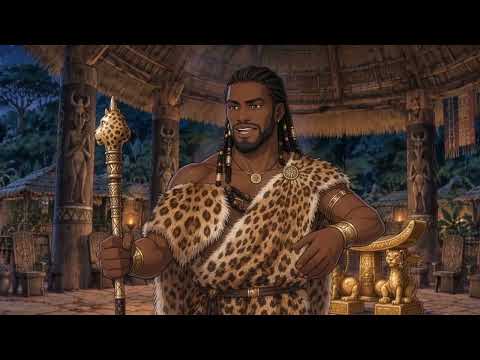
Even the symbolic regalia of pre-colonial African rulers—leopard skins, feathered crowns, solar disks or halos in beadwork—mirror the vestments of solar kings like Montuhotep. Some Bantu oral traditions speak of ancestral birds of fire and falcon spirits that led the people from the north—mythical remnants, perhaps, of the falcon-headed deity of war who once ruled the highlands of Thebes.
Conclusion: Montu and the Legacy of Solar Kingship
Montu is more than a war god of ancient Egypt. He is a manifestation of African sacred kingship, embodied in falcon form and blazing with solar fire. His cult represents an ancient African philosophy of leadership rooted in vision, justice, and divine mandate. His presence spans dynastic Egypt and echoes into the ancestral memories of Bantu-speaking peoples.
Pharaohs like Montuhotep knew this truth and capitalized on Montu’s symbolic weight to legitimize their reign. But beyond temple walls and royal inscriptions, Montu’s influence may have taken flight with the very falcons that symbolized him—migrating southward in spirit, memory, and metaphor, across the vast terrain of African culture.
Today, as African spiritualities reclaim their philosophical depth and metaphysical origins, Montu invites us to reimagine kingship not just as rule, but as sacred stewardship—of the land, the people, and the cosmic order of Ma’at.